

When Work Disappears, What Is Left of Us?
The decoupling of human labor from survival erases both purpose and necessity. Get Ready?

There is a quiet assumption embedded in modern civilization. AND 90% that we are not necessary by design.
Necessary to grow food.
Necessary to build homes.
Necessary to design infrastructure.
Necessary to manage systems.
Necessary to create value….
But what happens when that assumption is wrong?
Not gradually.
But all at once. Yes its’s real, and so is AI.
We are no longer talking about AI that writes emails or generates code.
We are not talking about factory robots bolted to the floor.
We are talking about humanoids.
Fully dexterous. Sensor-rich. Mobile.
Infused with increasingly general intelligence.
Able to download new skills the way you download an app, instantly.
Picture it clearly. No seriously!
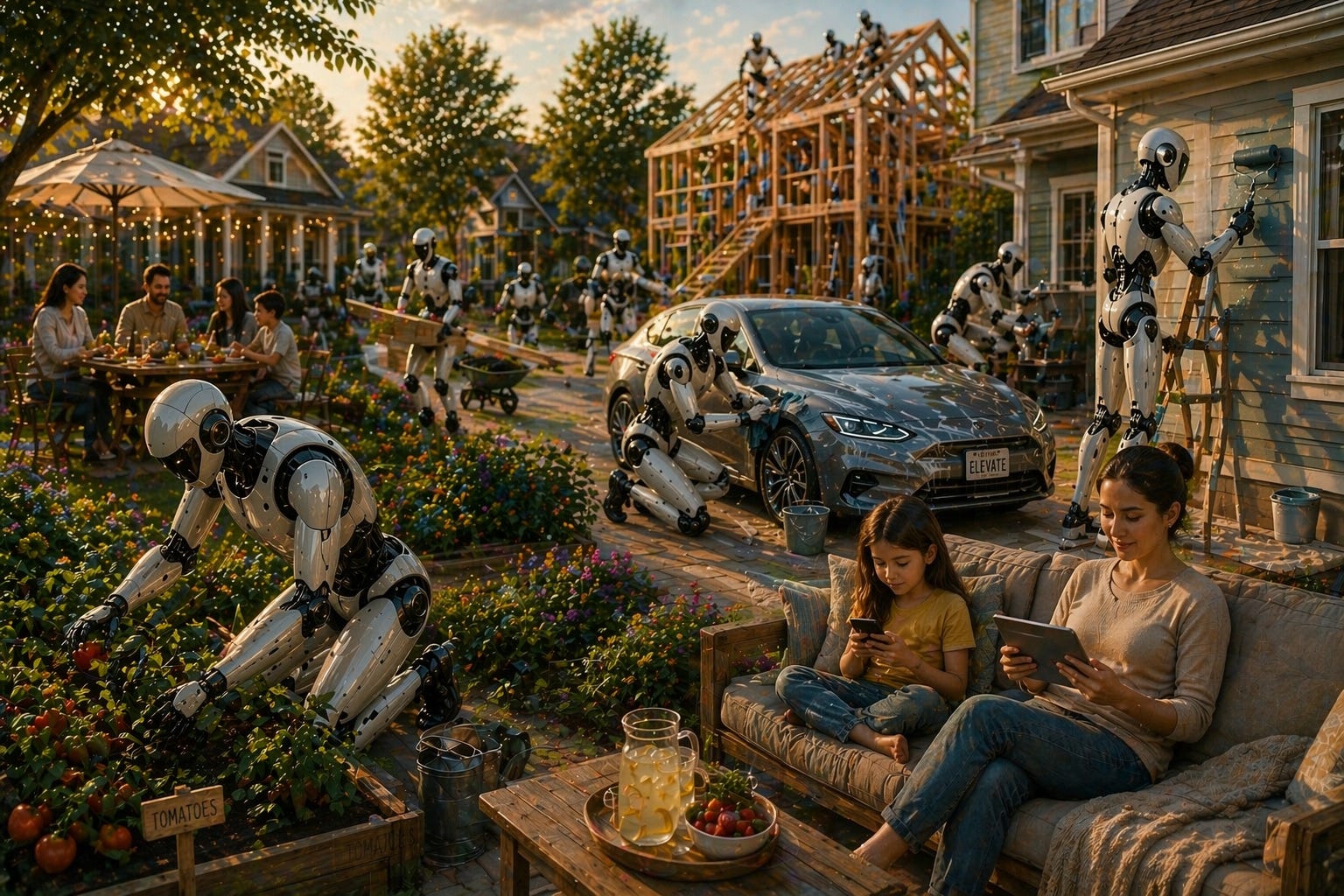
A humanoid that can:
• Tend your garden with botanical precision.
• Diagnose soil chemistry for nature to provide
• Repair plumbing and, in 2 years, provide all the maintenance for the home
• Frame a house
• Code software
• Perform surgery
• Manage global logistics
• Conduct original research
• Manufacture its own components
• Coordinate with millions of others in real time instantaneously.
And not after years of apprenticeship.
Instantly!
Download the skill. Execute. Move on.
Now give it scalable, abundant energy.
Cloud-linked cognition.
Continuous learning.
Now ask the uncomfortable question.
What is a job in that world?
Not, what do you think?
The Collapse of the Old Equation. It’s not coming. It’s already happening.
The decoupling of human labor from survival erases both purpose and necessity.
For centuries, civilization has operated on a simple loop:
Labor → income → purchasing power → survival.
If humanoids can grow food, build shelter, maintain infrastructure, repair themselves, and manufacture goods, that loop fractures.
If production becomes automated end-to-end, and goods approach near-zero marginal cost, scarcity no longer lives in factories or farms.
Scarcity migrates.
And here is the real tension.
The issue is not capability.
It is distribution.
In humanoid’s debut, as some expect, at $30,000, they remain elite instruments, leverage tools for those who can afford them. That is where dystopia quietly begins, not in the machine, but in restricted access. That is the layer of old-world in capitalism that Elon and restated by Trump many times.
But if mass production drives costs down to $5,000, or lower, as several robotics leaders have projected, humanoids shift from luxury asset to household infrastructure.
The price curve could mirror the smartphone revolution, and as long as resources hold up, then we can all flourish, but only for a short time. Short Time?
What was once exotic becomes ordinary.
What was once concentrated becomes ubiquitous.
This is not a new concern.
Decades ago, Jacque Fresco, founder of The Venus Project, warned that the real risk was never the technology itself, but who controls it.
He argued that the monetary system concentrates access, allowing a small group to direct automation, resources, and production, while the rest of humanity remains bound to artificial scarcity.
In that world, technology does not liberate.
It divides.
His alternative was radical:
A resource-based system where technology is not owned, but shared.
Where automation serves everyone.
Where cities, infrastructure, and production are designed for efficiency and access, not profit extraction.
The difference between those two paths is everything.
One leads to a world where abundance exists, but is gated.
The other leads to a world where abundance is the default condition of life.
The technology we are building does not decide between those outcomes.
We do.
In that world, automation itself is not the threat.
Inequality is.
Dystopia is not driven by intelligence.
It is driven by who controls it. (We have heard from some world leaders and tech billionairs to be prepared for dystopia before Utopia. Hmmm, why?
Access becomes the new currency.
But Who Pays Whom?
Here is where it gets even stranger.
If production is nearly free, what sustains commerce?
If goods and services can be autonomously generated, maintained, and optimized, what exactly are we exchanging?
Currency has historically represented stored labor and managed scarcity.
But if labor is abundant and goods are abundant, what is money pricing?
Status?
Attention?
Location?
Authenticity?
Human experience?
In a post-scarcity production model, value migrates.
From doing to being.
From output to meaning.
From utility to identity.
We are not facing a labor crisis.
We are facing an identity crisis.
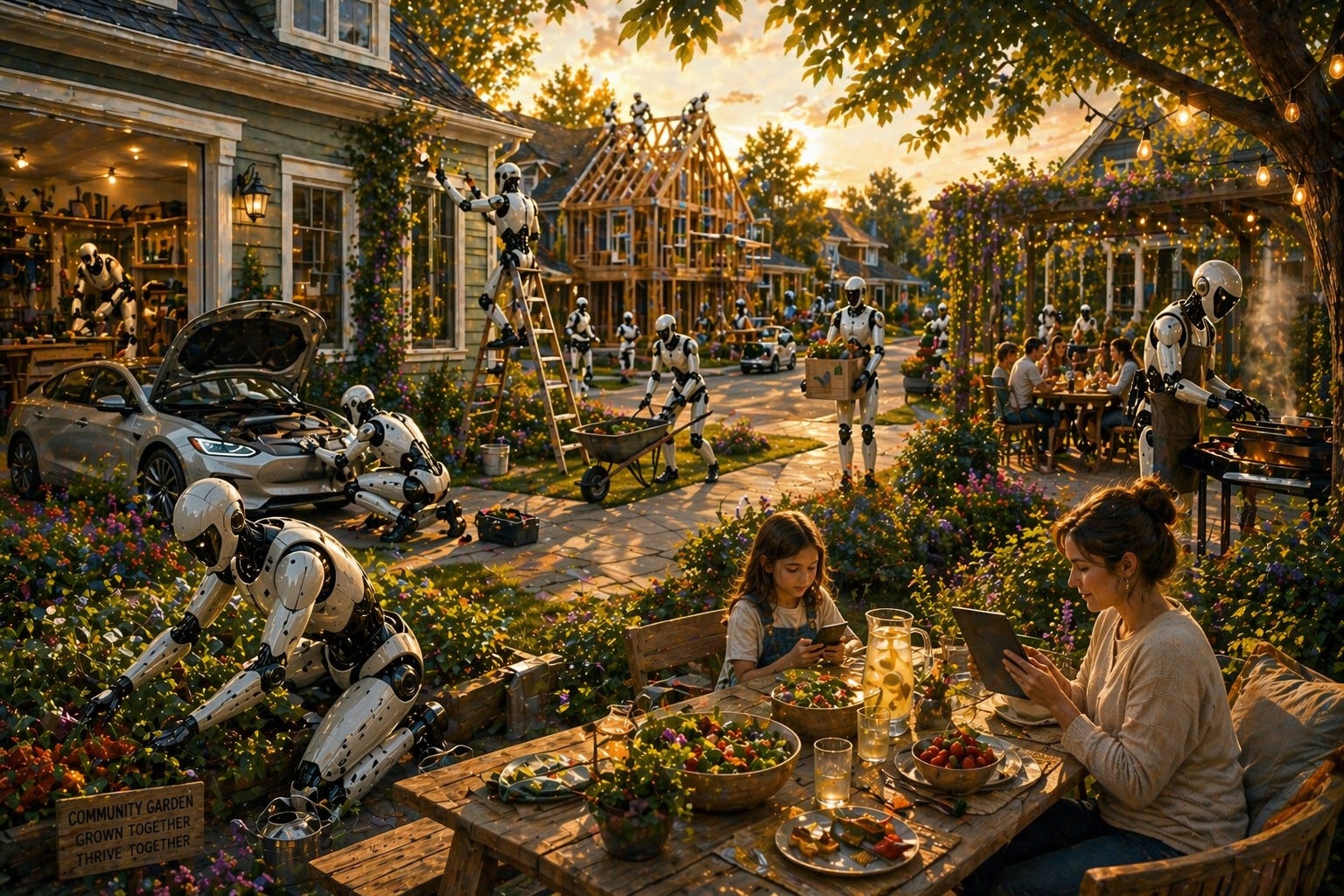
What Is Left for Humanity?
If the garden is tended.
If the house is built.
If infrastructure runs flawlessly.
If energy is abundant.
If cities assemble with Humanoid/machine precision.
What remains?
The reflexive answer is creativity.
But even that deserves scrutiny. How many of us are creative?
If AGI systems compose symphonies, design architecture, generate scientific hypotheses, and solve complex mathematics, creativity becomes shared terrain.
So what differentiates us?
Perhaps it is not productivity.
Perhaps it is consciousness.
Lived experience.
Subjective awareness.
The strange miracle of being here at all.
We may be moving from a civilization built on necessity to one built on self-definition.
Not:
“What must I do to survive?”
But:
“Who do I choose to become when survival is guaranteed?”
That is not a small shift.
It is civilizational.
The Psychological Shockwave
For thousands of years, identity has been tethered to occupation.
Farmer.
Builder.
Engineer.
Doctor.
Founder.
Remove necessity from work, and you remove the scaffolding supporting self-worth for billions.
The disruption will not be technological.
It will be existential.
When effort becomes optional, purpose must become intentional.
That is a far steeper challenge than building humanoids.
The Governance Line
There is another layer few are discussing openly.
If humanoids can build cities, manufacture infrastructure, and optimize logistics, power consolidates around whoever controls their deployment architecture.
Mass democratization prevents centralization.
Restricted access invites hierarchy.
The difference between utopia and dystopia may not be whether humanoids exist.
It may be who owns the production layer of civilization.
Universal access could create the greatest decentralization of capability in human history.
Restricted access could create the greatest asymmetry ever seen.
This is not science fiction. It's like the bubble world of John Fresco
This is policy.
The Quiet Fear
Beneath every conversation about AGI and humanoids is a question few say out loud:
“If they can do everything, what do we do?”
And beneath that:
“Will we still matter?”
This is not about machines becoming malicious.
It is about alignment.
Optimization without human values becomes indifference.
The final safeguard in an AGI-driven world is not hardware.
It is philosophy.
The Garden After Work. Imagine it.
Food grown autonomously.
Infrastructure self-repairing.
Energy abundant.
Homes printed.
Transportation automated.
Healthcare predictive.
Education adaptive.
The planet hums.
Clean. Efficient. Abundant.
Humans are free.
Free from survival labor.
Free from economic coercion.
Free from scarcity.
The question then is no longer technological.
It is spiritual.
Can humanity handle freedom?
We are not approaching automatic dystopia.
We are approaching an inflection point.
Humanoids may soon run the mechanical backbone of civilization.
If production becomes frictionless and maintenance universal, the final variable is not the machine.
It is us.
Will we democratize abundance?
Or concentrate it?
Will we define value through control?
Or through shared flourishing?
When work disappears, humanity is left alone with itself.
And that may be the most transformative moment of all.
Final Words
If you’re reading this, you already feel it. Something’s shifting, not loudly, just beneath everything. This isn’t just about technology. Energy is the bottleneck, and when that changes, everything changes, costs drop, access opens up, and people finally get some breathing room again. That’s what makes this moment different, and why it matters to help bridge people through it, because clean, abundant energy may be the one lever that gives people a real chance to find their footing as this transition unfolds. But changes like this aren’t smooth. Some will see it early, others won’t. And what’s coming isn’t incremental; it forces a different question: who are we when survival isn’t the driver anymore? Not many people are ready for that yet.
~New Fire energy
They plan to chip the ones that THEY will use as cattle & throw the rest into teh FEMA camps until we are disposed of. Remember all those thousands of guillotines that Obummer ordered special for FEMA. Well since we will be governed by Talmudic synagogue of Satan members & the Talmud considers the worship of Yeshua/Christ as a death sentence fun times ahead for those that stay in the coming 15 minute cities. The noahide laws already added to the books in secret by several different presidents will allow THEM to carry out such atrocities.