

When Does “Free Energy” Begin? When Output Exceeds Input and Scaling Takes Over
Lets understand from Materials of science to Excess Heat. Ill Shown you a Step by Step in videos below. Its really cool to watch!

Before discussing how clean, abundant energy can be reproduced in a laboratory, we need to be precise about what people mean when they say “free energy.”
This is not energy from nothing. Even “nothing” is a physical state.
In engineering terms, when a system reaches a coefficient of performance (COP) above roughly 1.5, it produces more usable energy than is required to operate it. At that point, part of the output can be fed back to power the next unit, and then the next. As units are stacked and scaled, the system compounds.
Over time, the external input required to keep the system running becomes negligible relative to the energy produced. The device no longer exists primarily to sustain itself. Its role shifts to producing usable energy. That is the practical meaning of “free” in this context. The cost and energy required to run the system fade into the background.
Now that we’ve clarified that, let’s discuss how this will be implemented in the real world by some of the leading LENR companies today. (Please note that this list is only a few notable companies, as progress is being made by various companies, and we recommend reading more about the many companies in newfireeenrgy.substack.com publications for your research.)
LENR-Focused Companies Actively Demonstrating the Effect
Brillouin Energy
Nickel–hydrogen systems with long-running, controlled experiments. Brillouin has repeatedly reported COP values increasing to or above 1.5 under calibrated conditions. The company has gone through quieter development periods, but its work remains methodical and engineering-focused
Clean Planet (Japan)
Quantum Hydrogen Energy (QHe) reactors, backed by strong industrial partnerships and institutional support in Japan. Clean Planet reports energy densities more than 10,000 times that of chemical fuels like natural gas, underscoring the nuclear nature of the reaction. While the company does not widely publish independently verified COP figures, a COP above 1.5 is the recognized industry threshold for self-sustaining and scalable operation, which their commercialization efforts implicitly require.
ENG8 Energy
A solid-state energy cell architecture designed with scalability and manufacturability in mind. Excess energy is attributed to lattice-based effects. ENG8 has reported independent validation results showing COP values above 1.8 to 1.10, now scaling toward and my broader vision beyond 1.10. Validation has involved respected third parties, including Dr. Jean-Paul Biberian, the Instituto Eletrotécnico Português (IEP), and a leading U.S. laboratory.
Leonardo Corporation (Andrea Rossi)
The E-Cat lineage remains a subject of controversy, yet it is undeniably influential. Rossi’s work has pushed LENR discussions out of pure theory and into aggressive engineering claims. Leonardo Corporation has announced demonstrations, production plans, and a stated commercial delivery date of January 20, with claims of full energy output and no external intake. Ongoing analysis and documentation can be found at ecatthenewfire.com. I remain optimistic.
Mizuno Research Group (Japan)
Open-method LENR replications using palladium and nickel systems. Sustained excess heat has been reported by multiple independent laboratories. Mizuno’s work is included here because of its transparency and commitment to open procedures, which makes it especially valuable for public education and independent verification. Videos below.
From Theory to Plain Language
Now, let’s step away from company names and get grounded in how this looks from a layman’s point of view.
Back in 2018, we were already seeing simple heat-producing devices that demonstrated excess energy under controlled conditions. No combustion. No fuel is being consumed in the conventional sense. Just heat appears once the right materials, loading, and conditions are reached.
That early hardware matters. It shows the progression from basic experimental setups to repeatable effects. From there, the path forward becomes an engineering problem, not a question of whether the phenomenon exists.
Let's take a look at the earlier developments and how the LENR process works from the 2019 Video.
I wanted to share this update article to highlight the advancements in Tadahiko Mizuno's LENR technology. I'm still amazed by how effectively this earlier 2019 video explains the mechanics of the LENR process, below. While various labs adopt different approaches, utilize diverse materials, and refine their techniques in unique ways, this video continues to be one of the clearest step-by-step explanations accessible to the general public.
Part 1
Part 2
Below are the most recent updates on Tadahiko Mizuno's patent improvement and results. “LINK Below”
Analysis of Trigger Input for Nuclear Reactions Using SUS Alloys In the Current Release.
Tadahiko Mizuno
LINK: Hydrogen Engineering Development Application Ltd., Japan link is avail intermittently, so be patient.
Current Prototype Heater 2025
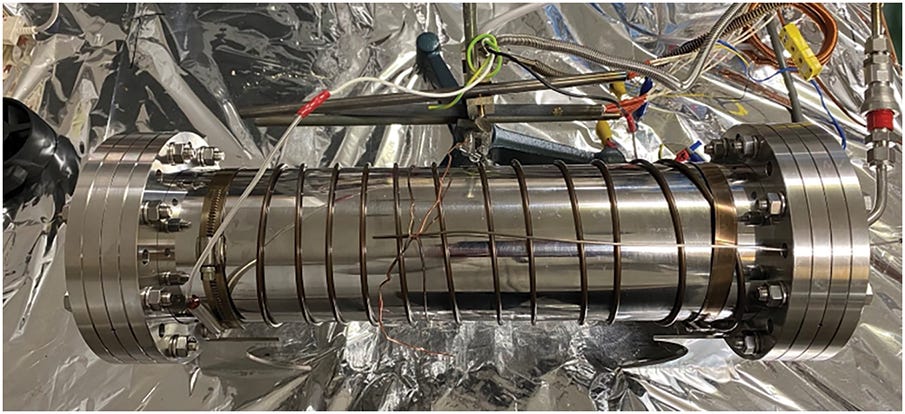
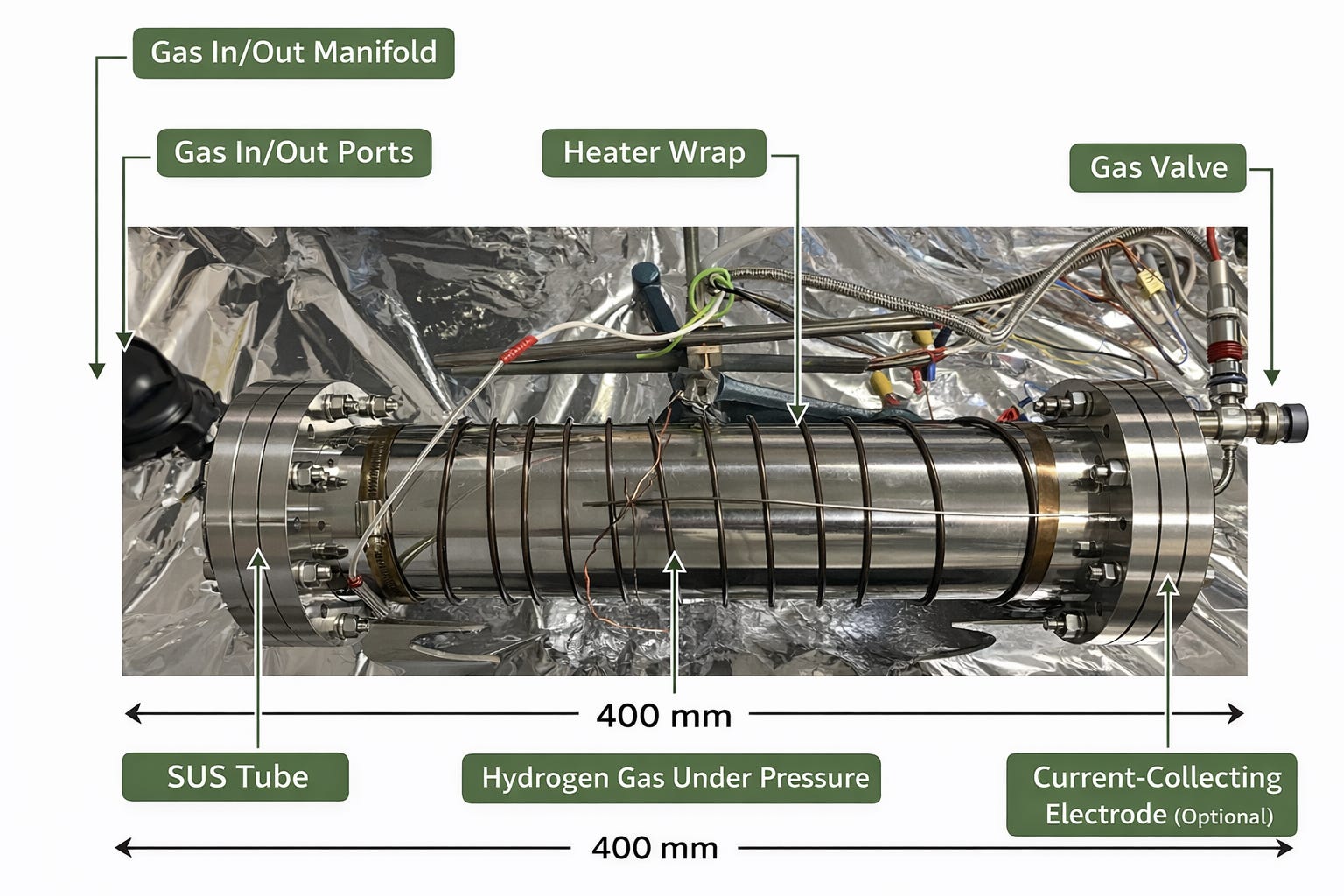
This image above shows Tadahiko Mizuno’s LENR reactor, a sealed stainless steel tube designed to absorb hydrogen into its metal lattice. After hydrogen loading, the chamber is evacuated and heated externally, triggering excess heat without combustion or fuel consumption. The simplicity of the design, no moving parts, no liquids, and minimal components, is what makes it so compelling and reproducible.
Conceptual illustration, below, for educational purposes only. Not an engineering schematic
History:
Mizuno Technology Inc., Japan

Tadahiko Mizuno, PhD, is a physicist, inventor and lead engineer of the technology of Mizuno Technology Inc.
Daniel Donatelli is the Chief Operating Officer
This company is probably the incorporation of what was previously known as “HEAD - Hydrogen Engineering Application & Development Company”
HEAD was an independent research unit working mainly with Ni/H derived technologies
In 1991 Mizuno operated a LENR experiment that proceeded to a runaway condition. Even after disconnecting the experiment from all input power it boiled 35 liter of water.
In 2005 another of Mizuno’s LENR experiments entered a runaway condition: During an electrolysis experiment, which normally would have transitioned to plasma electrolysis, the cell exploded forcefully. The accident was documented thoroughly in an ICCF-12 article.
Mizuno puplished experiments with plasma electrolysis, which achieved more excess energy output than most other LENR approaches at that time. The devices used tungsten cathodes with a small surface area and high current densities to perform electrolysis. The cothode was covered with a sheath of brightly-shining plasma.
Mizuno received funding from Industrial Heat
Mizuno is the author of a book about LENR: Nuclear Transmutation: The Reality of Cold Fusion which describes his early experimental work
His latest type of published experiments is based on palladium-rubbed nickel meshes with gas loading of deuterium or protium. In some cases the palladium was sputtered on the meshes by means of a low-pressure plasma discharge.
As of 2020 the new Mizuno Tech web site states: “Even rudimentary small devices can output 10-15kW of thermal energy which can be converted to steam or to spin super-critical CO2 turbines for producing combined heat and power for homes and factories”. Furthermore it claims: “With just simple engineering and using semiconductor mass production technology the output can be scaled up to large quantities of excess heat, making the technology interesting for wide range of applications”.
Mizuno is the author of an international patent application filed by Clean Planet Inc, Hydrogen Eng Application & Development Co, granted in 2018 as AU2014291181B2
~New Fire Energy Inc.
Disclaimer: