

The Vacuum Diode That Changed How the E-Cat NGU Makes Electricity
What Andrea Rossi Actually Patented and Why Control Replaced Fuel

TL;DR
Forget the fuel and the heat. One of Andrea Rossi’s most consequential recent patents is not a reactor patent at all. It is an electrical architecture patent built around a pulsed, magnetically confined vacuum diode. Whether or not the broader E-Cat NGU claims ultimately hold, this patent signals a clear shift toward direct electricity, control, and product-level design, and that alone changes the conversation.
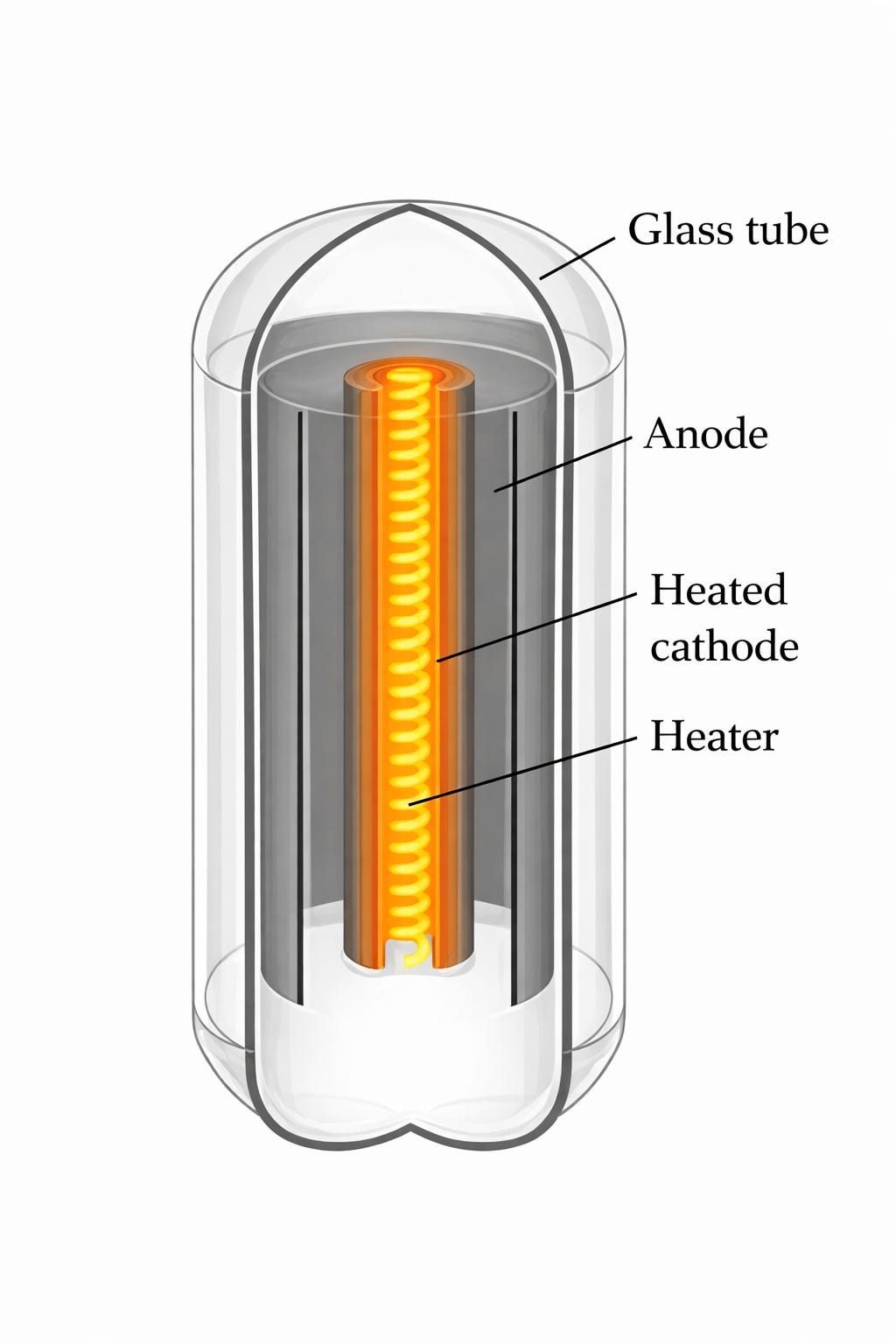
What this patent is and what it is not
This patent does not describe exotic nuclear physics or reaction pathways. It defines the structure of an electrical system.
The patent does not describe
nuclear reactions
fuel compositions
isotopes or catalysts
a thermal conversion cycle
The patent does describe
a power supply architecture
pulsed electrical operation
magnetic confinement
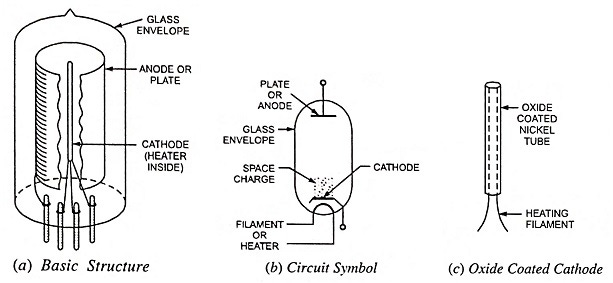
a vacuum diode acting as an active electrical element
Read plainly, it looks like the electrical extraction and stabilization layer of a system meant to deliver direct electricity, not just heat.
The core idea in plain language
The system consists of:
a voltage source and an electrical load
a one-way “check valve” enforcing current direction
a vacuum diode producing an electron beam
a magnetic field aligned with that beam
pulsed control tuned by a controller (including AI-based control)
high-permittivity materials surrounding the electrodes
The central claim is simple:
The vacuum diode in the E-Cat NGU isn’t a generator by itself; it’s the interface where carefully timed electrical pulses and magnetic fields shape electron behavior in vacuum, allowing the system to deliver stable electrical output.
[ Voltage Source ]
        |
   [ Check Valve ]
        |
  [ Vacuum Diode ]
   (electron beam)
        |
      [ Load ]
        ^
   pulsed control
.............................................................................
Conceptual block diagram illustrating the functional relationships described in the patent. Diagram shows electrical flow and control logic, not physical construction.
Everything else in the patent exists to support that sentence.
This is not chemistry.
It is not a thermal cycle.
It is electron dynamics under engineered boundary conditions.
This diagram shows functional relationships only, not physical dimensions or construction details.
Why the diode matters
In power electronics, diodes are how you:
enforce directionality
prevent destructive backflow
suppress oscillations
stabilize pulsed systems
The patent’s emphasis on one-way current makes one thing clear: the problem being solved is control, not fuel chemistry.
That matters if the goal is a modular, grid-facing device, not a lab experiment.
Pulses, magnets, and coherence
The patent repeatedly emphasizes:
pulsed waveforms
magnetic fields aligned with electron flow
high-permittivity ceramic materials at the electrodes
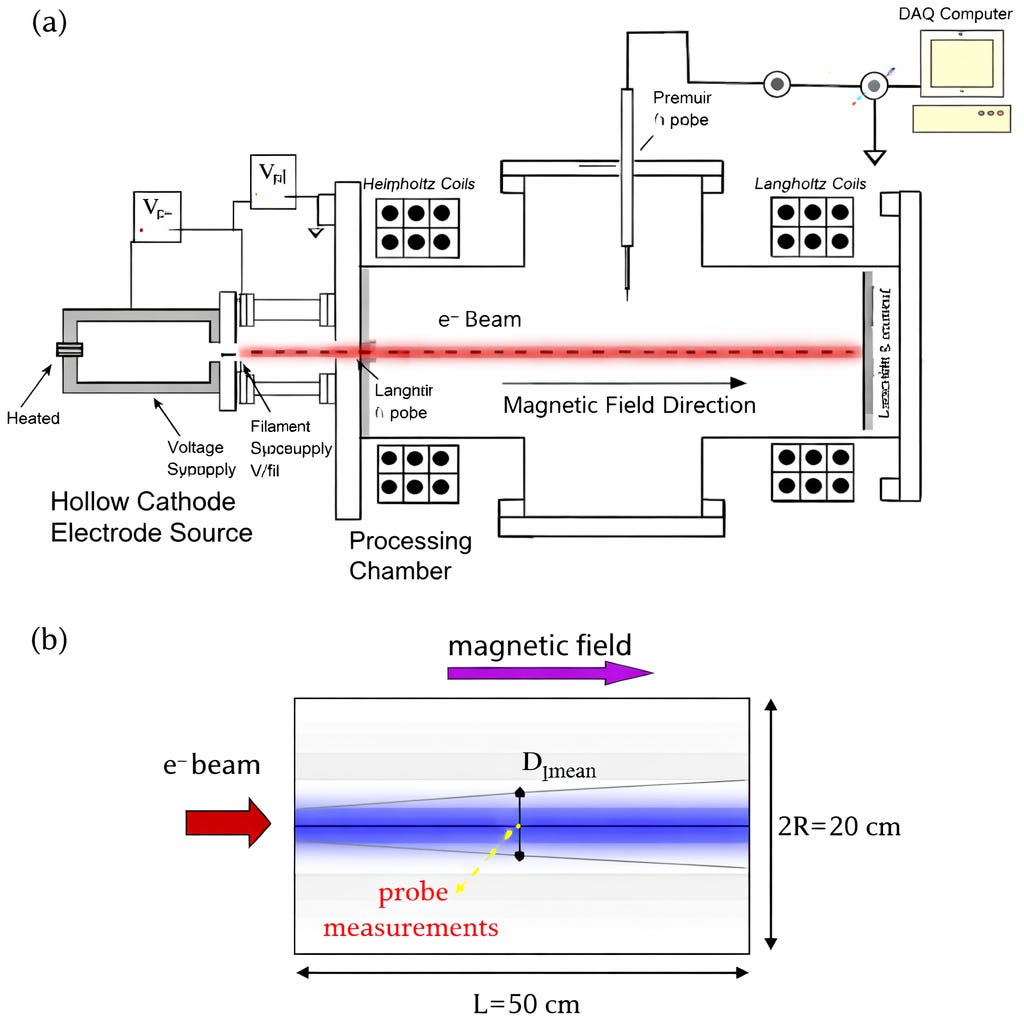
Illustration of an electron beam aligned with an external magnetic field, used to visualize confinement and measurement concepts referenced in the patent. Diagram represents experimental geometry, not a specific device implementation.
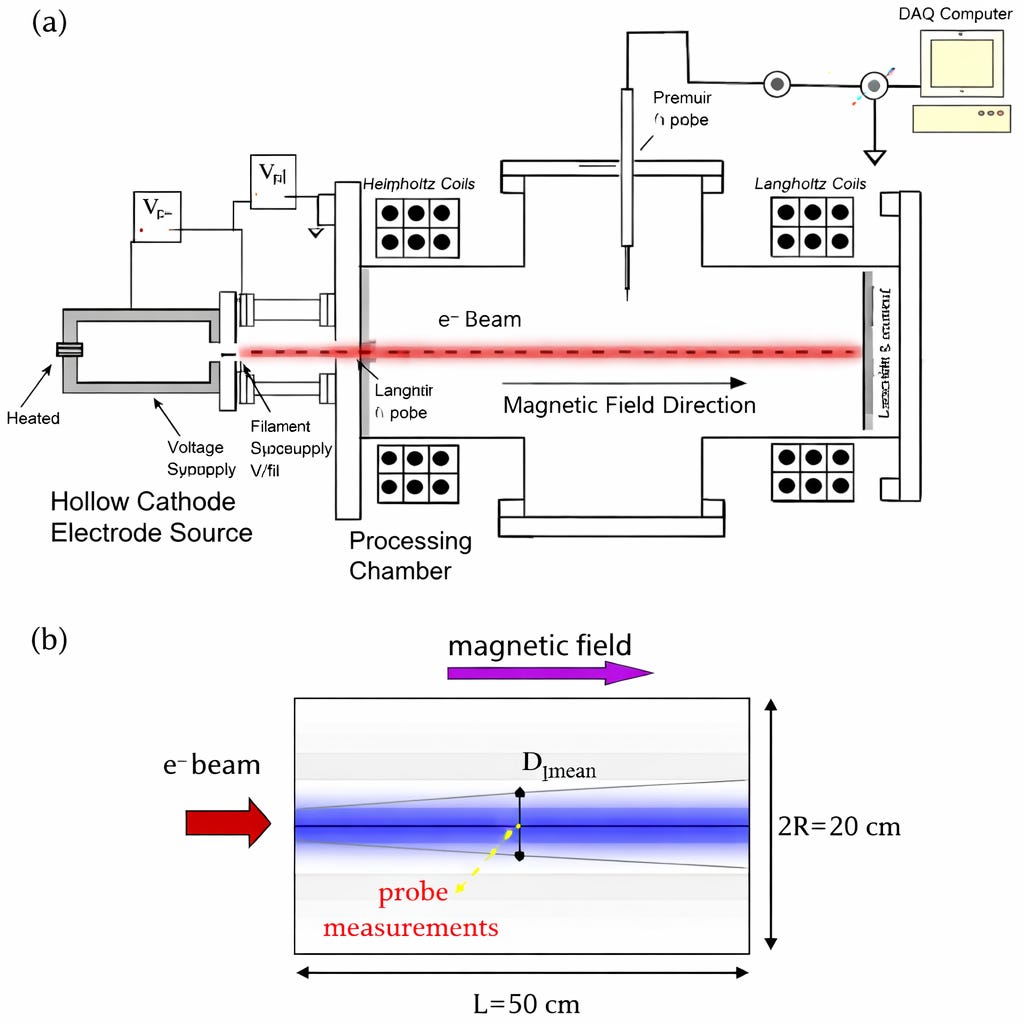
In conventional terms, this is about shaping space-charge behavior and stabilizing electron motion inside a vacuum gap.
Rossi refers to “coherent electron clusters.” Whether one accepts that terminology or not, the intent is clear: the vacuum diode is being treated as an active medium, not a passive component.
Where “zero-point energy” actually fits
Here is the most important credibility point:
This patent does not explicitly claim extraction of zero-point energy.
What it does describe is a system that engineers non-equilibrium boundary conditions in a vacuum environment and claims a net electrical contribution from that behavior.
When “zero-point field” language appears in Rossi’s broader framing, the most accurate interpretation is not energy pulled from nothing, but the vacuum responding differently when constrained, pulsed, and shaped by materials and fields.
That is a narrower claim and an important one.
Why this fits the E-Cat NGU direction
If the NGU is meant to be:
modular
solid-state
scalable
electrically native
Then control becomes the hardest problem.
This patent reads like an answer to that problem. It marks a shift away from heat-centric narratives and toward electrical behavior, stability, and productization.
The necessary reality check
Physics accepts that the vacuum is not empty. Quantum fluctuations exist.
What has not been demonstrated is reliable, repeatable extraction of net usable energy from the vacuum under independent verification.
That does not invalidate the architecture.
It does mean performance claims must be tested, not assumed
What Would Validate It and What Rossi Says Has Been Done
If the vacuum-diode architecture described in the patent is real, validation follows a conventional electrical-engineering path. Andrea Rossi has stated, at various times, that each of these steps has been addressed during development and testing.
What follows pairs validation requirements with Rossi’s own publicly stated positions, presented as attributed statements rather than verbatim quotations.
Independent input–output measurements
What validation requires
Direct measurement of electrical input and electrical output using standard instrumentation, performed independently, without thermal inference or assumed values.
What Rossi has stated
Between 2022 and 2025, Rossi has repeatedly stated that E-Cat NGU testing involved direct electrical measurements performed by external engineers, emphasizing that both input and output were measured electrically using standard instruments rather than inferred from heat.
Operation under real electrical loads
What validation requires
Stable operation while powering real electrical loads, not open-circuit demonstrations or laboratory surrogates.
What Rossi has stated
Since 2023, Rossi has stated that the NGU is designed for direct electrical use and that testing has included operation under real electrical loads rather than purely diagnostic configurations.
Long-duration stability
What validation requires
Continuous operation over extended periods without manual intervention, performance drift, or degradation.
What Rossi has stated
From 2023 through 2025, Rossi has stated that NGU units have undergone extended periods of continuous operation during endurance testing, without reported degradation during those runs.
Transparent accounting of pulse energy
What validation requires
Full accounting of pulsed electrical energy, including waveform timing, amplitude, and duty cycle, with net output appearing at the load.
What Rossi has stated
Following the filing and subsequent granting of the vacuum-diode power-supply patent (filed 2022, granted 2025), Rossi has stated that the NGU control system tracks pulse parameters and that energy accounting is performed electrically, including the full pulsed waveform rather than averaged values.
What This Establishes and What It Does Not
Taken together, these statements outline a standard engineering validation pathway, not an exotic one. They describe how Rossi claims validation has been pursued, not confirmation that it has been independently verified. Any independent verification would occur only after a licensee demonstrates acceptable performance under current external testing.
Whether these claims ultimately withstand independent scrutiny remains the determining factor.
No mysticism.
No assumptions.
Just instrumentation, duration, and independent confirmation.
Bottom Line
This vacuum diode patent does not prove that the E-Cat NGU works. What it does do is clarify the system’s design logic and how electrical control, rather than fuel chemistry, sits at the center of the architecture.
Rossi has consistently stated that the E-Cat NGU does not rely on batteries or stored energy, and that its electrical output is produced intrinsically by the system rather than drawn from stored sources.
That shift alone makes the architecture worth serious attention. The next step is straightforward: independent validation by the licensee, demonstrating stable performance under real, grid-scale conditions.
~New Fire Energy Inc.
Disclaimer: This article is provided for educational and analytical purposes only. It discusses publicly available patent material and statements made by Andrea Rossi and does not constitute independent verification of performance, efficiency, or energy gain. All technical descriptions reflect interpretation of published information and inventor statements, not confirmed experimental validation.
Nothing in this article should be construed as investment advice, an offer to sell, or a solicitation to buy securities or products of any kind. Readers should conduct their own independent due diligence and rely on verified sources before concluding.
New Fire Energy Inc. is not affiliated with, does not represent, and does not sell products for Andrea Rossi, Leonardo Corporation, the E-Cat, or the E-Cat NGU. Any references to these technologies are made solely for technical discussion and public analysis.
This is some great detail on this device. I've been following Andrea Rossi and actually learned a lot reading this article. I would consider myself an electrical engineer and would agree on your dialogue. Great information. Thank you!!!