

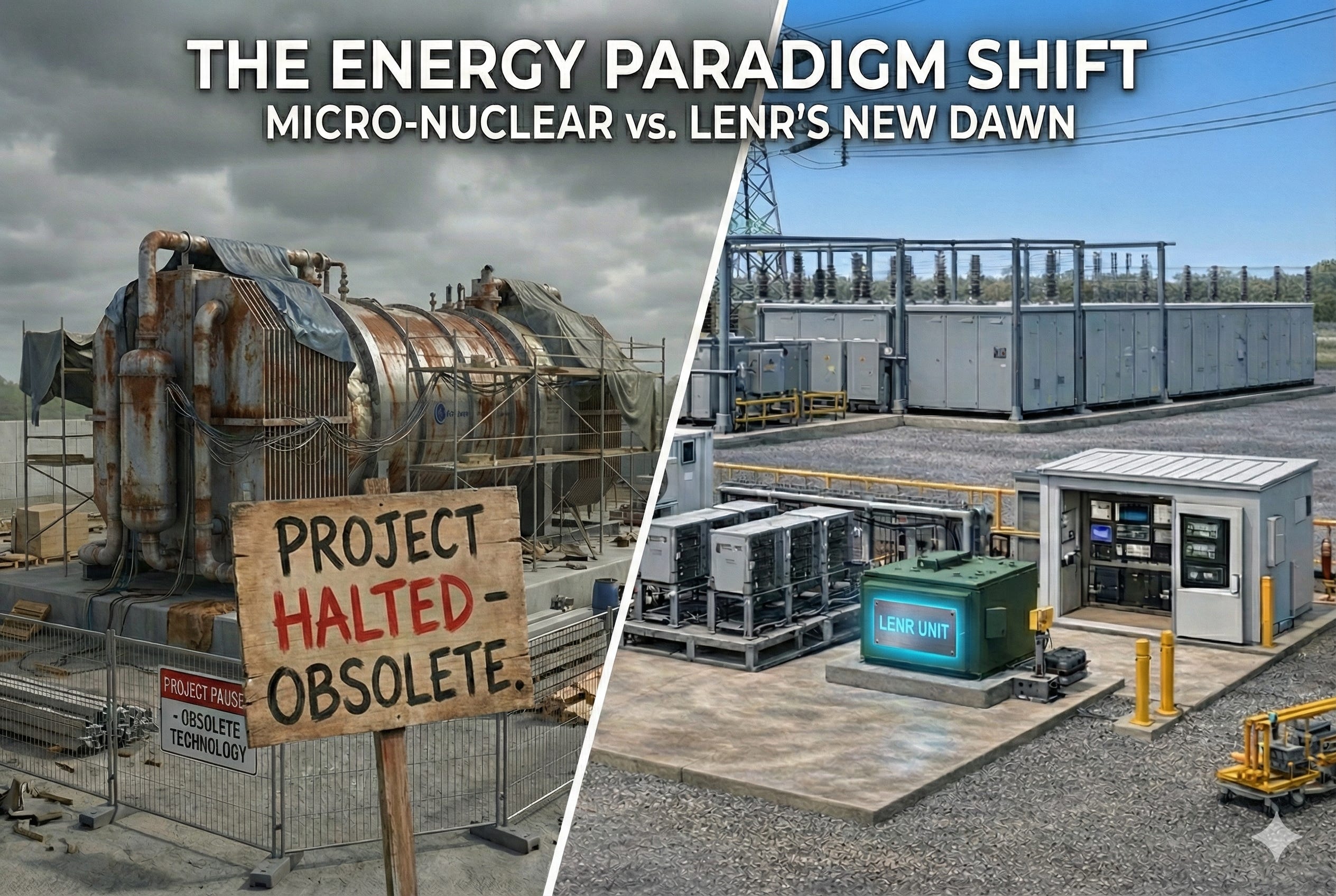
Billions of dollars are being spent right now to solve an energy problem that we can start seeing in the rear-view mirror.
Governments, utilities, and institutions believe they’re funding the future. In reality, they’re refining the last version of an energy system built on scarcity, regulation, and slow deployment.
That would be fine if the world still moved slowly.
It doesn’t.
The energy conversation has already shifted quietly from whether new systems are possible to how long old assumptions can survive. Most people won’t notice the change until it becomes unavoidable. By then, much of today’s capital will already be trapped on the wrong side of the transition.
This isn’t about belief.
It’s about timing.
And timing is tightening.
According to the World Nuclear Industry Status Report (July 31, 2025),
“Small modular reactors are not expected until the 2030s, by which point renewables and energy efficiency may have displaced their demand.” World Nuclear Industry Status Report
As Jean-Paul Biberian, longtime LENR physicist and former Professor of Physics at Université Aix-Marseille, has stated:
“The reality of excess heat in LENR experiments is no longer in question. The issue now is understanding the mechanisms and making the effect reliable and reproducible.”
This reflects a growing consensus among energy analysts that renewables and breakthrough energy technologies are advancing on a faster timeline than micro-nuclear deployment, challenging the assumption that small reactors will be the backbone of the next energy system.
The Mistake Everyone Is Making
How Real Breakthroughs Actually Appear
You recognize this moment because you’ve seen the pattern before.
Real breakthroughs don’t announce themselves loudly. They repeat quietly, consistently, under pressure.
That’s why LENR-type systems, including Andrea Rossi’s E-Cat NGU, aren’t selling ideas. They’re protecting precision. Discipline in language is the tell. That’s how serious operators behave when something works and uncontrolled diffusion becomes the real risk.
The resistance didn’t come because it was wrong.
It came because it displaced people.
New physics, like new markets, threatens identity before it threatens models.
My Wall Street instinct flagged this for the same reason it always does: unrelated systems were beginning to show the same behavior.
That’s regime change.
You weren’t chasing belief.
You were tracking a pattern that kept repeating under pressure.
The Core Assumption That’s Failing
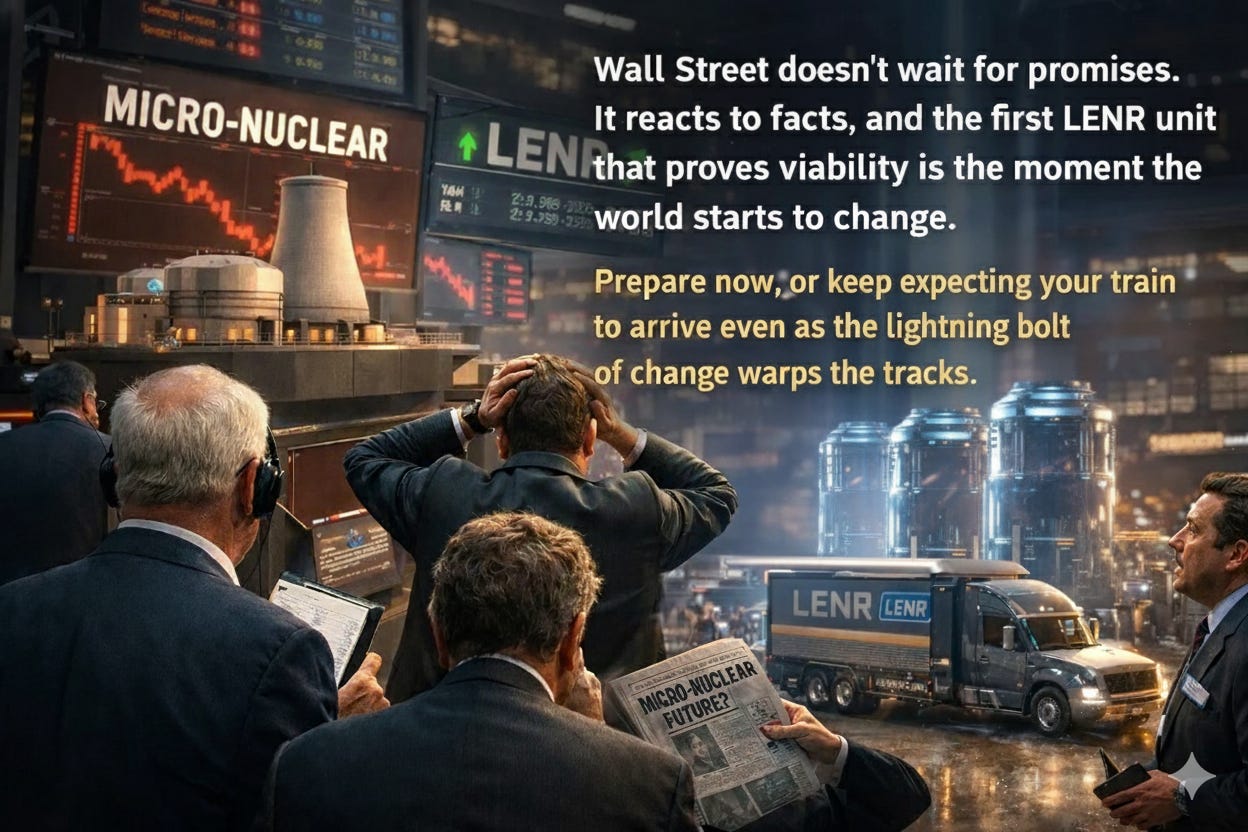
The assumption behind microgrids and micro-nuclear power is simple: energy scarcity will continue, so we must manage it more effectively.
That assumption is already breaking.
AI didn’t just change software. It collapsed timelines across materials science, modeling, simulation, and engineering. What once took decades now takes years. What took years now takes months. Energy, once a slow-moving sector, has become the bottleneck everything else is crashing into.
The field didn’t just evolve. It changed shape.
Why Legacy Frameworks No Longer Hold
Most energy investments are still evaluated through old frameworks:
Grid-first thinking
Centralized deployment
Long regulatory timelines
Thermal efficiency assumptions
Static interpretations of thermodynamics
Those frameworks were built for a slow-moving world.
That world is gone.
We’re now in a convergence phase. AI, quantum modeling, advanced materials, automation, and robotics are advancing in tandem. When that happens, only one thing matters: removing constraints.
Energy is the largest remaining constraint.
LENR: The wild card no One Budgeted For
Low-Energy Nuclear Reactions (LENR) were dismissed for decades, not because nothing was happening, but because what was happening didn’t fit institutional comfort zones.
That excuse no longer holds.
Through NFE, we’ve visited multiple companies and labs where excess energy has been observed. Different mechanisms. Different materials. Different architectures. The common result is simple and uncomfortable: output exceeds input.
Once that happens, the debate stops being philosophical.
It becomes practical.
Engineering.
Scaling.
Reliability.
Manufacturing.
And unlike micro-nuclear, LENR does not require:
Massive capital projects
Decades-long permitting
Centralized grids
Fixed fuel chains
Many LENR systems are becoming solid-state, compact, and modular. They don’t plug into the old system.
They bypass it. (Plug-and-play.)
The Hard Truth About Microgrids
Microgrids aren’t evil.
They aren’t stupid.
They’re late.
They are optimized for a scarcity model that is dissolving under exponential pressure. If even one LENR-based system proves itself in real-world deployment, especially in something as ordinary as an industrial substation, the economic logic behind microgrids collapses almost overnight.
That isn’t hyperbole.
That’s how paradigm shifts work.
It only takes one valid, working product.
This is why the energy debate is no longer technical. It’s structural.
Staying Comfortable Inside Familiar Assumptions
Kodak is the classic example of optimizing what already exists while missing what is replacing it. As a former Kodak executive later admitted:
“We didn’t lose because we didn’t see digital coming. We lost because we were too good at film.”

Harvard Business School case studies summarize Kodak’s failure not as technological blindness, but as strategic inertia driven by profitable legacy models. The company kept refining scarcity just as the constraint itself was disappearing.
Micro-nuclear plants and microgrids risk the same mistake: perfecting scarcity at the very moment it begins to dissolve.
Another Example of Missed Timing
A more recent parallel comes from artificial intelligence.
Elon Musk didn’t step away from AI because he believed it wouldn’t matter. He stepped away because he believed it would matter later. When the curve bent sooner than expected, catching up required enormous capital, massive computing investment, and time that couldn’t be recovered.
When attention is spread too thin, early signals are easy to miss.
Speed doesn’t matter if the compass is broken.
Direction does.
Timing isn’t linear. It’s multidimensional. Seeing what matters requires stepping outside a single timeline and understanding how technology, incentives, and human behavior move at different speeds.

A similar moment appeared in energy in 2024.
While many labs and institutions were still testing the waters, Andrea Rossi made a public outreach that reflected a very different understanding of timing.
Public message on X (Twitter)
Date: November 10, 2024
Account: Leonardo Corporation (official)
@elonmusk
Dear Mr. Musk,
“It would be a pleasure and an honor to show you our E-Cat NGU technology, which we believe could be very interesting and useful to you.”
Please feel free to contact me anytime.
Warm regards,
Andrea Rossi
CEO, Leonardo Corporation
The message wasn’t about publicity.
It was about inflection points.
Transformation rarely announces itself when it’s convenient. It begins quietly, often dismissed as premature or peripheral, and only later reveals how costly delay really was.
Rossi has stated publicly that E-Cat NGU systems have been delivered for industrial use in modular, megawatt-class configurations, though exact physical dimensions have not been publicly disclosed.
“The Ecats that are delivered are already industrialized.”
— Andrea Rossi, January 3, 2026
(Journal of Nuclear Physics blog, response to reader Sergio)
The Bigger Picture Most People Avoid
Energy abundance doesn’t just disrupt utilities.
It restructures everything!
Manufacturing decentralizes. Homes and EVs move off centralized grids. Logistics reorganize. Energy-intensive desalination becomes cheap. Food systems shift. AI data centers shrink dramatically. Labor assumptions break. Long-dated energy bonds lose relevance. Fiat currencies struggle to stabilize when energy and production stop being limiting factors.
When constraints disappear, behavior changes.
That reality is uncomfortable.
So most people look away.
But ignoring it doesn’t slow it down
Final Words · Publisher’s Note
This isn’t hype.
It’s timing.
History rarely ends with legacy systems being perfected. It moves on when something simpler, faster, and structurally different appears. We’ve seen this cycle repeat across technology, finance, and infrastructure.
Micro-nuclear and microgrids may function, but they’re built for a world that is already changing underneath them. By the time they are fully deployed, permitted, and scaled, the assumptions they rely on may no longer hold.
When energy becomes abundant, the world doesn’t upgrade existing systems. It reorganizes around new constraints, new economics, and new behaviors. That transition doesn’t wait for long timelines or institutional comfort.
From what we’ve seen firsthand, energy technology is now moving on compressed timelines. What once took decades is being forced into years, and in some cases months. That shift is already underway.
Andrea Rossi has stated publicly that E-Cat NGU systems have been delivered for industrial use in modular configurations designed for integration into existing facilities. While independent public validation is anticipated, the broader direction is clear: compact, modular, and fast-to-deploy energy systems are increasingly where momentum is moving.
You’re not here chasing belief.
You’re tracking the signal.
And the signal suggests the next energy era won’t be built on the same foundations as the last.
~New Fire Energy
Disclaimer
This article is provided for informational and educational purposes only. It reflects forward-looking perspectives, personal analysis, and publicly available statements related to emerging energy technologies, including LENR and the E-Cat NGU. References to individuals, companies, or technologies are based on publicly disclosed information and do not imply endorsement, partnership, or investment solicitation.
Any forward-looking statements involve inherent uncertainty and risk. Actual outcomes may differ materially as technologies evolve, regulatory environments change, and independent validation progresses. Nothing in this article should be construed as financial, investment, legal, or technical advice.
Readers are encouraged to conduct their own independent research and exercise critical judgment.
Great article Steve, forrunning is an exciting and at times very lonely place to create! We push on because we are the pushers, know you have a backing that the rest of the collective will catch up in due time as usual. Honored to be lonely at times, because we know the destination will be well worth it!
It may happen, but it will not be for the benefit of people. The very same critters will be in charge & determining the rate they will charge for your privilege to be able to buy their power. 15 minute cities, digital ID that will allow THEM to remove your access to whatever THEY want, whenever THEY decide to. Not eating enough bugs & you cannot get anything but bugs to eat. No retirement for you either you will work until THEY decide you are ready to donate your organs for the uhhh greater good. Get caught jay walking they just take the fine money directly out of your account, didn't get the latest required vaccine, no power or water. In the last stage they lock you out of your little apartment space and you live on the streets like is happening in China right now. It all started back in 2017 for them. Look it up, Fox news & CNN sure as hell ain't gonna cover it either. Next look up the percentage of people by country that received at least one mRNA vaccine. If you are one of those that got them, sucks to be you. The window is 5 to 8 years. Look up what was inscribed on the Georgia Guidestones, did you perhaps think THEY were kidding? Or maybe you still believe politics and voting are real? The final mortality numbers will be about 15 to 20% lower than the vaccinated number. That is because 30% of the jabbs were just saline, as their personal form of mercy. However, THEY have been adding the mRNA jabbs to your commercially raised big box store beef, pork, chicken, fish. If you have been buying farmer rancher/farmer direct, at least you missed that round attacks. Along with putting them into dental Novocain shots, your pet rabies and other shots and many other as well, so that 15% to 20% may turn out to be kind of high? That is why the Rossi ECat individual units were so attractive. There is much more, but I seriously doubt most can even read this without squealing and having a frothing fit about it not being true. You will learn the Hard way.